
How Long Does It Take to Learn a Language? What the Research Says
If you’re learning a foreign language for a particular reason — an exam, a new job, university or a move abroad — you’ve probably wondered how long does it take to learn a language.
You might have come across estimates suggesting that it takes around 200 hours to move from one language level to the next. It’s a figure often used by language schools and educational institutions, and it can be helpful when planning a course.
But what does it actually mean? Are 200 hours enough to progress from B1 to B2? Does learning German take the same amount of time as learning English? And why do some learners seem to progress much faster than others?
To explore these questions, we’ll look at the Common European Framework of Reference for Languages (CEFR), estimates published by Cambridge English and the Goethe-Institut, and research into how people learn foreign languages.
What does a CEFR level actually mean?
The Common European Framework of Reference for Languages (CEFR), developed by the Council of Europe, describes language proficiency across six main levels: A1, A2, B1, B2, C1 and C2.
Each level describes what someone can do in a foreign language.
At A1, learners can introduce themselves, answer simple personal questions and understand familiar everyday expressions.
At B2, they can understand the main ideas of complex texts, discuss both concrete and abstract topics, and express and defend their opinions with a reasonable degree of fluency.
At C2, learners can understand virtually everything they hear or read and communicate fluently, precisely and appropriately, even in complex situations.
What the CEFR does not establish, however, is the number of hours required to reach these levels.
The CEFR describes language proficiency, not the time it takes to develop it.
Another important point is that the six levels are not equally spaced. Moving from A1 to A2 does not necessarily require the same amount of time as moving from B2 to C1.
As learners advance, they are expected to do more than expand their vocabulary or learn additional grammar structures. They need to understand increasingly complex information, communicate with greater precision and adapt their language to different situations.
This is one reason why estimating the time needed to reach a particular level is not as straightforward as it might initially seem.
Where does the estimate of 200 hours come from?
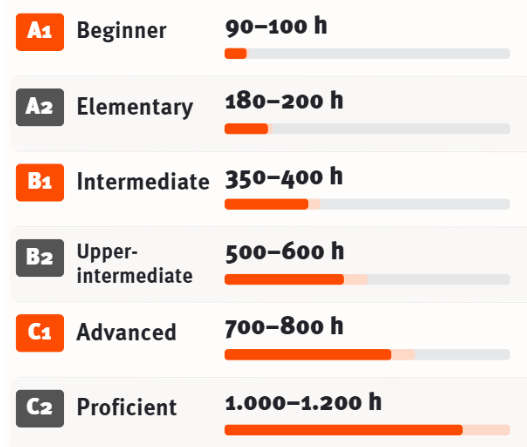
Cambridge English suggests that approximately 200 guided learning hours may be needed to progress from one CEFR level to the next.
This is a general guideline rather than a fixed requirement. Cambridge also provides estimates of the cumulative number of hours needed to reach different proficiency levels, starting from beginner level.
| CEFR level | Estimated cumulative guided learning hours |
| A1 | 90-100 |
| A2 | 180-200 |
| B1 | 350-400 |
| B2 | 500-600 |
| C1 | 700-800 |
| C2 | 1000-1200 |
These figures are cumulative. For example, the estimated 500–600 hours for B2 represent the total learning time from beginner level, not the additional time needed to progress from B1 to B2.
What counts as a guided learning hour?
The distinction between classroom hours and guided learning hours is particularly important.
According to Cambridge, guided learning includes lessons as well as structured or supervised learning activities, such as assignments and exercises organised by a teacher.
For example, someone who attends two hours of lessons per week and completes another two hours of teacher-assigned activities may accumulate approximately four guided learning hours during that week.
Other activities, such as watching films, listening to podcasts, reading books or using language-learning applications, can also contribute to progress. However, informal contact with a language is not automatically counted in the same way as guided learning.
The difference lies in how the activity is organised and what the learner is expected to achieve.
It is also worth remembering that Cambridge’s published estimates refer to learning English. They are useful reference points, but they should not automatically be applied to every foreign language.
How long does it take to learn German? The Goethe-Institut estimates
For German, the Goethe-Institut provides its own estimates of the amount of instruction associated with different CEFR levels.
According to the Goethe-Institut, reaching B2 may require approximately 600–800 teaching units of 45 minutes each.
The Goethe-Institut Brussels also publishes approximate cumulative estimates for different levels.
| CEFR level | Approximate cumulative hours (60 minutes) |
| A1 | 60-150 |
| A2 | 150-260 |
| B1 | 260-490 |
| B2 | 450-600 |
| C1 | 600-750 |
| C2 | 750+ |
These are indicative figures rather than guaranteed timelines. The amount of instruction required can vary depending on a learner’s previous experience, individual needs and learning circumstances.
Can we compare the Cambridge and Goethe-Institut estimates?
Cambridge estimates that reaching B2 in English may require approximately 500–600 guided learning hours, while the Goethe-Institut estimates around 450–600 hours of instruction for B2 in German.
At first glance, the figures appear quite similar. However, they are not measuring exactly the same thing.
Cambridge’s guided learning hours include lessons and supervised or structured study. The Goethe-Institut expresses its estimates in teaching units, with each unit lasting 45 minutes.
The figures therefore provide useful points of reference, but they should not be interpreted as proof that English and German require exactly the same amount of time to learn.
They are best understood as planning estimates that help learners and educational institutions organise language programmes and set realistic expectations.
Why does progress often take longer at higher levels?
The first stages of learning a language often bring noticeable progress.
After a relatively short period, beginners may be able to introduce themselves, talk about their families, ask for directions, describe their daily routines or handle simple conversations.
These are significant achievements, and they are usually easy to recognise.
At more advanced levels, progress can become less visible.
A learner working towards B2 or C1 is not simply trying to learn more words. They are developing the ability to understand complex information, communicate spontaneously, explain abstract ideas and adapt their language to different situations.
For example, an A2 learner might be able to describe a recent holiday or explain their plans for the weekend.
At B2, that same learner might be expected to discuss the social and environmental impact of tourism, compare different perspectives and support an opinion with arguments and examples.
The difference is not just the amount of language someone knows. It is also what they can do with that knowledge.
In his 2018 report How Long Does It Take to Learn a Foreign Language?, Ben Knight examines different scenarios for language development and explains why learning time varies according to the learner and the learning environment.
The report also illustrates why progression at higher levels can require a greater investment of time.
The estimates discussed in the report are intended to support educational planning. They are not experimentally established timelines that can predict the progress of every individual learner.
An estimate of 200 hours can be a useful planning tool, but it should never be treated as a deadline.
Why do some learners progress faster than others?
Two learners may attend the same course, work with the same teacher and use similar materials, yet make very different amounts of progress.
Research into language learning suggests that there are several reasons for this.
One study by Elder and O’Loughlin (2003) followed 112 students attending intensive English-language programmes in Australia and New Zealand.
Over a period of approximately 10–12 weeks, participants achieved an average improvement of around half an IELTS band. However, the results varied considerably between individuals.
The researchers also observed differences between language skills. Listening showed particularly noticeable improvements, while progress in reading was more limited.
A later study by Kang and colleagues (2021) investigated 52 Korean students preparing for IELTS.
After three months, the average improvement was approximately 0.3 IELTS bands. The researchers identified study hours and initial proficiency as possible predictors of progress, although the relationship between these factors and learning outcomes was not straightforward.
The students also progressed differently across individual skills, with the greatest improvements observed in writing and the smallest in speaking.
These studies measured IELTS performance rather than progression between CEFR levels. They also focused on English, not German.
Nevertheless, they illustrate an important point: language development is not uniform, even when learners study in relatively similar conditions.
Previous learning experience, motivation, starting proficiency, study habits, the quality of instruction and opportunities to use the language can all influence progress.
A general estimate cannot account for every individual difference.
Does it matter how old you are when you start learning?
Many people assume that children are naturally better at learning foreign languages than adults.
The relationship between age and language learning, however, is more complicated.
One important distinction is between learning a language through extensive immersion, such as living in a country where it is spoken, and learning it in a classroom for a limited number of hours each week.
These two learning environments can produce different outcomes.
The Barcelona Age Factor Project
The Barcelona Age Factor Project, associated with researcher Carmen Muñoz, examined the development of learners who had started studying English at different ages.
The research compared learners after approximately 200, 416 and 726 hours of instruction.
At the earlier measurement points, the comparisons included children, adolescents and adults. The later measurement involved groups who had begun learning during childhood.
The findings suggested that, in classroom-based foreign language learning, older beginners often progressed more quickly during the initial stages when the amount of instruction was comparable.
One possible explanation is that adolescents and adults can make more deliberate use of learning strategies and draw on their existing linguistic and educational experience.
They may also find it easier to understand abstract explanations or recognise patterns across languages.
This does not mean that adults always learn languages faster than children. Nor does it mean that starting early offers no advantages.
In immersive environments and over longer periods, early language learning can be beneficial, particularly for certain aspects of language proficiency.
The important point is that age cannot be considered separately from the conditions in which learning takes place.
What did researchers find in Switzerland?
Pfenninger and Singleton (2016) investigated 200 Swiss learners of English who had started learning at different ages, approximately eight and thirteen.
Their findings showed that later starters progressed more rapidly in some respects. By the end of compulsory schooling, the researchers did not identify a general advantage associated with starting earlier.
Motivation, learning context and individual experience also played important roles.
These findings challenge the assumption that beginning foreign language lessons at the youngest possible age will automatically produce better results.
For adults considering learning a new language at 30, 40 or 50, the research offers an important perspective.
Starting later does not prevent someone from making substantial progress. The way they study, the learning environment and the opportunities they have to practise are also important.
How we approach language learning at Lektor
At Lektor, we believe that language development involves more than attending lessons.
Classroom activities provide structure, guidance, feedback and opportunities for communication. However, learning also continues between sessions.
Our aim is to connect these different parts of the learning process so that learners can gradually develop greater confidence and independence.
Connecting classroom learning with independent practice
In our course planning, we allocate approximately 60 teaching units of direct instruction for a CEFR level, complemented by structured independent activities and guided practice.
This is part of our course organisation, rather than a guarantee that every learner will reach a particular level after a fixed number of hours.
We encourage learners to engage with the language outside the classroom, but we also try to give those activities a clear purpose.
For example, we might recommend a YouTube video, a podcast or even a short Instagram reel.
Rather than simply asking learners to watch it, we might connect it to a task: identifying key information, answering comprehension questions or discussing the content during the next lesson.
Vocabulary applications and interactive exercises can also be useful. They offer opportunities for repetition and help learners consolidate words and structures.
However, recognising the correct answer in an exercise is not necessarily the same as being able to use that language spontaneously.
That is why we aim to connect individual practice with communication activities in class.
The role of extensive reading
We also encourage extensive reading, which involves reading accessible and interesting material in relatively large quantities.
The aim is to develop reading fluency, improve vocabulary recognition and become increasingly familiar with the language.
Depending on their level, learners might read simplified stories, short novels or other materials that match their interests and abilities.
We may then use these texts as starting points for discussions, recommendations or exchanges of opinions.
Not every reading activity needs to be followed by a test. Reading for enjoyment and developing a regular reading habit are valuable in themselves.
Why we include B1+ and B2+ in our course structure
Another feature of our course organisation is the use of intermediate stages such as B1+ and B2+.
The CEFR defines six main proficiency levels, but language development does not always fit neatly into six equally sized stages.
Intermediate stages allow us to organise learning into smaller steps and provide additional opportunities to consolidate skills.
For example, the transition from B1 to B2 involves more than expanding vocabulary or learning new grammar structures.
Learners need to become more confident when dealing with complex texts, following longer conversations, expressing nuanced opinions and producing well-organised spoken and written language.
Using an intermediate stage such as B1+ allows us to work towards these objectives progressively.
The same principle applies to B2+, which can help learners strengthen their upper-intermediate skills before moving towards C1.
These stages are not additional main CEFR levels. They are useful subdivisions that support course planning and provide a more gradual progression.
Of course, no course structure can eliminate individual differences or guarantee a particular outcome after a fixed number of lessons.
What it can do is provide a clear learning path, appropriate challenges and opportunities to practise and consolidate new skills.
So, how long does it take to learn a language?
There is no single answer that applies to everyone.
Cambridge English and the Goethe-Institut provide useful estimates that can help learners understand the amount of study associated with different proficiency levels.
Research also shows that progress depends on a combination of factors, including previous experience, motivation, learning strategies, study intensity and opportunities to use the language.
The number of hours matters, but it is only part of the picture.
If you’re preparing for an exam, planning to study abroad or learning a language for professional reasons, a realistic learning plan should take both your starting point and your goals into account.
It should also leave room for individual differences and recognise that language development is not always linear.
At Lektor, we aim to combine structured lessons, independent practice and meaningful communication so that learners can gradually develop the skills they need.
Ultimately, the goal is not simply to accumulate a certain number of learning hours. It is to develop the ability to use the language confidently and effectively.
–
References
- Council of Europe (2001). Common European Framework of Reference for Languages: Learning, Teaching, Assessment.
- Cambridge English (2026). Guided learning hours.* Cambridge English Support.
- Knight, B. (2018). How long does it take to learn a foreign language? Cambridge University Press.
- Elder, C., & O’Loughlin, K. (2003). Investigating the relationship between intensive English language study and band score gain on IELTS. IELTS Research Reports, Volume 4.
- Kang, O., Ahn, H., Yaw, K., & Chung, S.-Y. (2021). Investigation of relationships between learner background, linguistic progression and score gain on IELTS. IELTS Research Reports Online Series.
- Muñoz, C. (2010). On how age affects foreign language learning. In Advances in Research on Language Acquisition and Teaching.
- Pfenninger, S. E., & Singleton, D. (2016). Affect trumps age: A person-in-context relational view of age and motivation in SLA.Second Language Research, 32(3), 311–345.
- Goethe-Institut. Goethe-Zertifikat B2 – Requirements and learning hours
- Goethe-Institut Belgium. FAQ German courses and exams.
Newsletter
Abonează-te la newsletterul nostru și fii la curent cu ultimele noutăți


